 https://twitter.com/home https://www.facebook.com/Shabbir.Hussain191
By Shabbir Hussain
DUSHANBE, May 27 (Diplomatic Star): Tajikistan’s Foreign Minister, Sirojiddin Muhriddin, has called on the international community to intensify cooperation and accelerate implementation efforts to tackle growing global water challenges, warning that the world is falling behind in achieving water-related sustainable development goals.
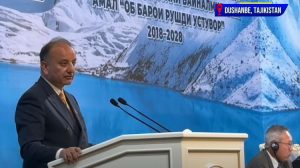
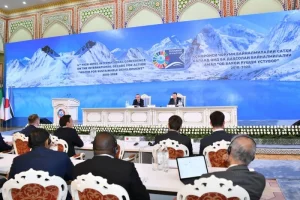
Addressing delegates, representatives of international organizations, development partners, and policymakers at the 4th High-Level International Conference on the International Decade for Action “Water for Sustainable Development” 2018–2028 in Dushanbe, Muhriddin stressed that water security has become one of the defining issues of the 21st century and requires urgent, coordinated, and sustained global action.
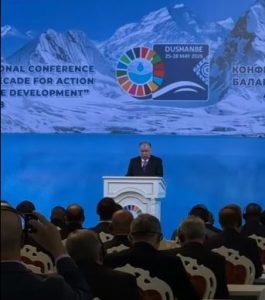
The conference, being held from May 25 to May 28 in the Tajik capital, has brought together governments, experts, international institutions, civil society organizations, and development partners to assess progress under the Water Action Decade and identify priorities for the years ahead.
Opening his remarks, the foreign minister expressed gratitude to UN-Water and participating countries for supporting the conference and contributing to global dialogue on water issues. He noted that Dushanbe has emerged as an internationally recognized platform for discussions on water cooperation and sustainable development.
“Dushanbe has increasingly become a global platform for water dialogue, cooperation and action,” he said, emphasizing the city’s growing role in facilitating international consensus on one of the world’s most pressing development challenges.
Muhriddin recalled that nearly a decade ago, the United Nations General Assembly unanimously adopted the International Decade for Action “Water for Sustainable Development” 2018–2028, following an initiative proposed by Tajikistan and supported by member states around the world. 
He said the adoption of the Decade reflected a common understanding among nations that water lies at the heart of sustainable development and is indispensable for poverty reduction, food security, public health, environmental protection, and economic growth.
According to the minister, the Decade was designed to strengthen sustainable water resource management, improve implementation of water-related targets under the Sustainable Development Goals (SDGs), promote international partnerships, facilitate knowledge exchange, and ensure universal access to safe drinking water and sanitation services.
“As we approach the final phase of the Decade and prepare for the 2028 United Nations Water Conference here in Dushanbe, we must honestly assess where we stand,” he told participants.
Reviewing progress achieved since the launch of the initiative, Muhriddin said the Water Action Decade has successfully elevated water issues higher on the international agenda. He noted that water is now increasingly viewed not only as a natural resource but also as a strategic factor influencing economic development, climate resilience, regional stability, and international cooperation.
The minister highlighted a number of growing global threats that continue to place unprecedented pressure on water resources worldwide. These include water scarcity, pollution, ecosystem degradation, glacier retreat, prolonged droughts, devastating floods, and climate-related disasters.
He warned that climate change is increasingly manifesting itself through water-related impacts, affecting communities, economies, and ecosystems across the globe.
“Climate change continues to reveal itself primarily through water,” he said, stressing that rising temperatures, changing precipitation patterns, and melting glaciers are altering water availability and threatening livelihoods in many regions.
Muhriddin further observed that global demand for water is increasing rapidly due to population growth, urbanization, industrial development, agricultural expansion, and technological advancement. These trends, he said, are creating additional pressure on already stressed water systems and highlighting the need for more efficient and sustainable water management practices.
Despite notable progress in raising awareness and mobilizing international action, the foreign minister acknowledged that the world remains significantly behind schedule in achieving Sustainable Development Goal 6, which seeks to ensure the availability and sustainable management of water and sanitation for all by 2030.
He pointed out that billions of people around the world still lack reliable access to safe drinking water and adequate sanitation services, underscoring the scale of the challenge facing the international community.
The minister identified the 2023 United Nations Water Conference as a major milestone in global efforts to address water issues. The conference generated nearly one thousand commitments through the Water Action Agenda, bringing together governments, international financial institutions, civil society organizations, academic institutions, youth groups, and private-sector stakeholders.
According to Muhriddin, these commitments demonstrated growing international recognition of the need for collective action and stronger partnerships to address water challenges.

He also underscored the significance of water diplomacy, particularly in Central Asia, where shared water resources play a critical role in regional stability and development.
The minister noted that dialogue and practical cooperation on transboundary water issues have helped build trust among neighboring countries, strengthened good-neighborly relations, and contributed to regional economic progress.
“Water diplomacy has proven to be an effective tool for fostering cooperation and mutual understanding,” he said, adding that collaborative approaches are essential for addressing shared challenges and ensuring equitable and sustainable use of water resources.
At the national level, Muhriddin highlighted Tajikistan’s ongoing efforts to modernize its water sector through reforms aimed at improving water infrastructure, expanding access to drinking water and sanitation, and promoting water-efficient technologies.
He said these efforts are being implemented under the country’s National Water Strategy until 2040, which seeks to enhance water security, strengthen resilience to climate change, and support sustainable economic development.
Regionally, Tajikistan remains committed to advancing cooperation through mechanisms such as the International Fund for Saving the Aral Sea, which focuses on addressing environmental and water-related challenges associated with the Aral Sea basin.
Looking ahead, the foreign minister stressed that the remaining years of the Water Action Decade must become a period of accelerated implementation, stronger partnerships, and measurable results.
He highlighted several priorities outlined in the proposed “Dushanbe Framework,” an initiative advanced by Emomali Rahmon. These priorities include closing the gap between commitments and implementation, increasing investments in water infrastructure and innovation, strengthening scientific research and digital technologies in water management, promoting inclusive participation, and reinforcing water’s role within the multilateral system.
Muhriddin emphasized that financial resources, technological innovation, and political commitment would be essential to achieving these objectives and ensuring that water remains a central element of sustainable development strategies worldwide.
“The years ahead will be decisive,” he said, referring to key international milestones including the 2027 SDG Summit and the 2028 United Nations Water Conference, which will again be hosted in Dushanbe.
He urged governments, international organizations, development institutions, and other stakeholders to use the remaining years of the Decade to translate commitments into concrete actions that deliver tangible benefits for communities around the world.
“Our task today is not only to review progress,” Muhriddin said. “Our task is to define how water cooperation can contribute to a more sustainable, resilient and prosperous world.”
Concluding his address, the foreign minister reaffirmed Tajikistan’s commitment to working closely with international partners and stakeholders to ensure that the final phase of the Water Action Decade produces meaningful outcomes and lasting impact.
He expressed confidence that through strengthened cooperation, increased investment, and shared responsibility, the international community can make significant progress toward achieving universal access to water and sanitation while building a more sustainable future for coming generations.