 https://twitter.com/home https://www.facebook.com/Shabbir.Hussain191
By Shabbir Hussain
ISLAMABAD, June 5 (Diplomatic Star): Leading climate experts, policymakers, disaster management professionals and private-sector representatives on Friday called for urgent integration of climate action into Pakistan’s development planning and budgeting processes, warning that the country can no longer afford fragmented responses to increasingly severe climate threats.
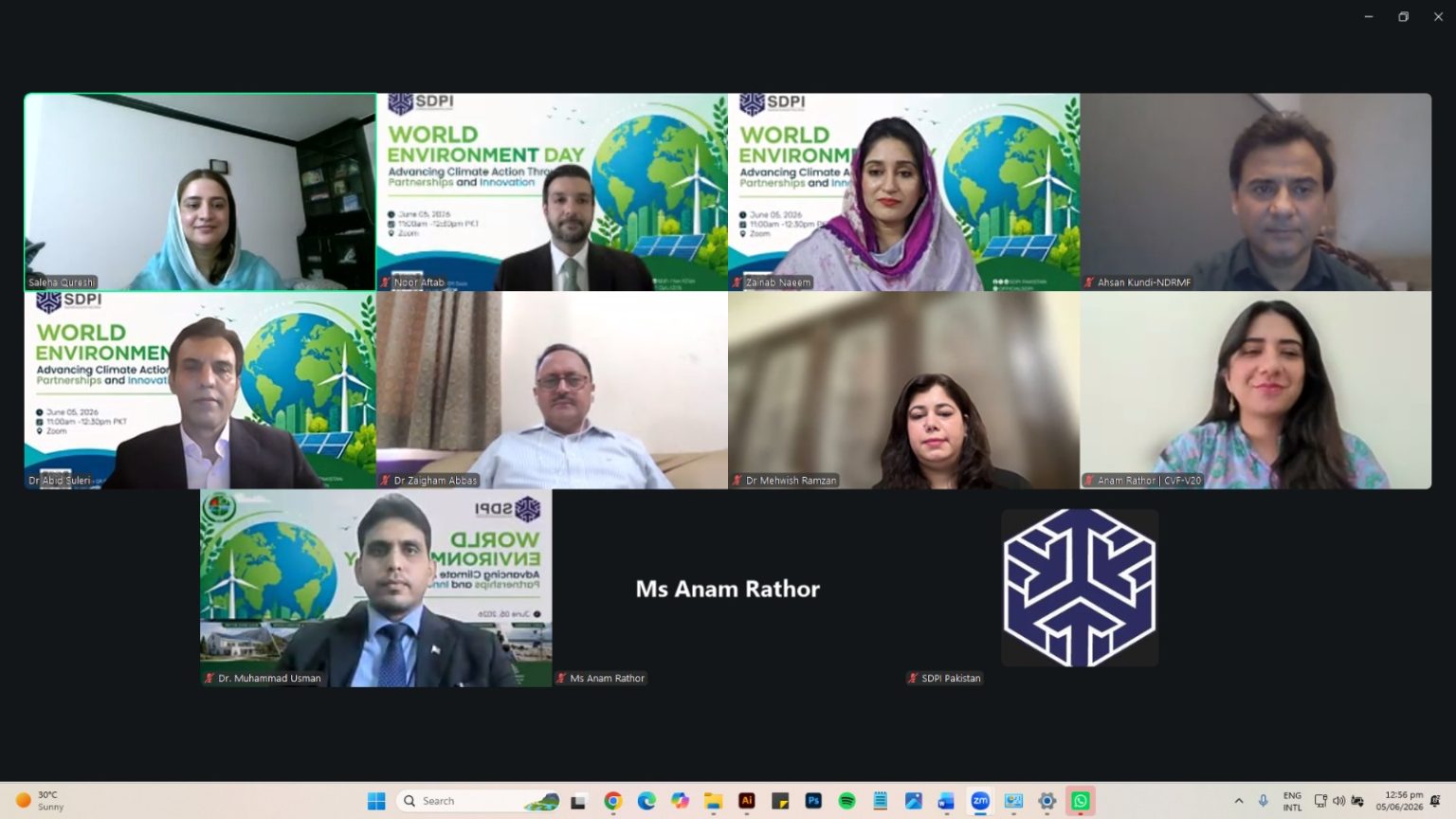
Speaking at a webinar titled “Advancing Climate Action through Partnerships and Innovation”, organized by the Sustainable Development Policy Institute (SDPI) to mark World Environment Day, participants emphasized the need for innovative climate financing, stronger disaster preparedness systems, climate-smart investments and enhanced collaboration between public and private sectors to build long-term resilience against climate-induced disasters.
The speakers noted that Pakistan remains among the countries most vulnerable to climate change despite contributing only a negligible share of global greenhouse gas emissions.
They stressed that climate adaptation and resilience-building must be treated not merely as environmental concerns but as critical economic and development priorities.
Opening the discussion, Dr. Abid Qaiyum Suleri, Executive Director of SDPI and Chairman of the Board of Directors of the National Disaster Risk Management Fund (NDRMF), said Pakistan’s climate challenges require evidence-based policymaking, innovative financial solutions and strong institutional partnerships.
He stressed that climate resilience should become a central pillar of Pakistan’s development agenda, with greater alignment between national policies, budget allocations and implementation at the provincial and local levels.
“Climate adaptation is not simply an environmental obligation; it is an investment in economic stability, livelihoods, infrastructure and future growth,” he said.
Dr. Suleri emphasized the need to scale up climate finance, improve coordination among federal and provincial governments and ensure that vulnerable communities remain at the heart of climate action strategies.
He also highlighted the critical role of research institutions and policy think tanks in supporting informed decision-making and fostering collaboration among stakeholders.
According to him, transforming Pakistan’s climate vulnerabilities into opportunities for sustainable and inclusive growth requires science-based solutions and coordinated action.
Delivering remarks as chief guest, Syed Abrar Hussein, Director General of the Pakistan Environmental Protection Agency (Pak-EPA), highlighted several environmental initiatives aimed at reducing pollution and promoting sustainability.
He said collaborative efforts on plastic waste management had successfully transformed confiscated single-use plastics into useful products such as benches, planters and waste bins for schools and public spaces.
The Pak-EPA chief also pointed to the successful conversion of 33 traditional brick kilns in Islamabad to environmentally friendly zigzag technology, which significantly reduces emissions and improves fuel efficiency.
In addition, he said cooperation with the steel industry had enabled the installation of bag-filter systems capable of capturing harmful emissions while facilitating the recovery of valuable zinc from industrial waste.
Hussein emphasized that climate policies must reach ordinary citizens, particularly farmers who are increasingly facing the impacts of changing weather patterns, water scarcity and declining agricultural productivity.
He called for stronger awareness campaigns, training programs and the promotion of climate-smart agricultural practices and water conservation techniques to strengthen resilience at the grassroots level.
Speaking on the broader development implications of climate change, Dr. Shafqat Munir, Deputy Executive Director (Policy) at SDPI, said climate change is no longer a future concern but a present-day development reality affecting every aspect of Pakistan’s socio-economic landscape.
He warned that climate impacts are increasingly threatening economic stability, food security, water resources, public health, livelihoods and social cohesion.
“Climate change is forcing us to move beyond isolated projects and fragmented responses,” he said. “The future demands stronger partnerships, bolder innovations and faster action.
If science, policy, finance and community engagement can be aligned effectively, climate resilience can become a practical development pathway for Pakistan and other vulnerable countries.”
Dr. Munir noted that recurring floods, prolonged droughts, devastating heatwaves and glacial hazards underscore the need to move from reactive disaster management to anticipatory action and risk-informed development planning.
Echoing these concerns, Dr. Muhammad Usman, Manager Research at the National Disaster Management Authority (NDMA), said recent climate-induced disasters have demonstrated the importance of early warning systems, anticipatory measures and community preparedness.
He explained that NDMA has strengthened its National Emergency Operations Centre, enhanced impact-based forecasting mechanisms and expanded the dissemination of early warning information through multiple communication channels to reach vulnerable populations.
Dr. Usman recommended integrating climate resilience standards into infrastructure projects and adopting risk-informed planning approaches that account for multiple hazards simultaneously.
He stressed the importance of addressing floods, heatwaves, glacial lake outburst floods and landslides through a comprehensive multi-hazard framework rather than treating each threat in isolation.
The discussion also focused heavily on climate finance, a critical issue for developing countries facing growing adaptation costs.
Sohail Maqbool Malik, Technical Team Lead at the Climate Resourcing Coordination Centre (CRCC), emphasized the need to convert Pakistan’s climate commitments into a robust pipeline of bankable and investment-ready projects capable of attracting international funding.
He noted that although global climate finance commitments have increased in recent years, Pakistan continues to face significant financing gaps despite requiring hundreds of billions of dollars to implement its Nationally Determined Contributions (NDCs) under international climate agreements.
According to Malik, improving project preparation, strengthening institutional capacities and creating investor confidence are essential for mobilizing large-scale climate investments.
Addressing the issue of international climate justice, Anam Rathore, Program Lead Pakistan at the Climate Vulnerable Forum and V20 Finance Ministers (CVF-V20), stressed the need for easier access to climate finance for vulnerable nations.
She argued that countries like Pakistan, which contribute little to global emissions yet suffer disproportionately from climate impacts, require stronger international support for adaptation, resilience-building and loss-and-damage financing mechanisms.
Rathore called for global financial systems to become more responsive to the needs of climate-vulnerable countries and emphasized that climate justice must remain at the center of international negotiations.
The importance of disaster risk financing also emerged as a key theme during the webinar.
Ahsan Kundi, Climate Change and Climate Finance expert at the National Disaster Risk Management Fund, highlighted efforts to strengthen Pakistan’s financial preparedness for disasters through public-private partnerships.
He said the NDRMF is supporting the development of Pakistan’s Disaster Risk Financing Strategy Framework, which aims to ensure that financial resources are available before disasters occur rather than relying solely on post-disaster assistance.
Kundi stressed that effective disaster financing requires close collaboration among government agencies, financial institutions, insurance companies, development partners and the private sector.
Such coordination, he said, would enable rapid deployment of funds for relief, recovery and reconstruction following climate-related disasters.
Representing the private sector, Noor Aftab, Director Corporate Affairs for Pakistan, the Middle East, North and West Africa at Tetra Pak, emphasized the importance of transitioning toward a circular economy and strengthening sustainable waste management practices.
He encouraged businesses to adopt “design for recyclability” principles and invest in recycling infrastructure while urging governments to create policy environments that support sustainable industrial practices.
Discussing Extended Producer Responsibility (EPR), Aftab advocated for a standardized national framework aligned with international best practices rather than fragmented provincial regulations.
Meanwhile, Dr. Mehwish Ramzan, Head of ESG, Environment and Climate Change Governance at Jazz Pakistan, highlighted the growing contribution of the corporate sector in promoting sustainability and green innovation.
She noted that environmental, social and governance (ESG)-driven business models are becoming increasingly important in accelerating Pakistan’s transition toward a low-carbon and climate-resilient economy.
According to Dr. Ramzan, private-sector investment in renewable energy, sustainable infrastructure and green technologies can play a transformative role in supporting national climate objectives.
The webinar, moderated by Saleha Qureshi, brought together a diverse group of experts, researchers, policymakers, development practitioners and corporate leaders to discuss pathways for accelerating climate action and sustainable development in Pakistan.
Participants concluded that Pakistan’s future resilience depends on its ability to mainstream climate considerations into all aspects of development planning, strengthen disaster preparedness, mobilize climate finance and build effective partnerships across government, business and civil society.
As climate risks continue to intensify, experts warned that delayed action could impose significant economic and social costs.
However, with coordinated policies, innovative financing and collective commitment, Pakistan has an opportunity to transform climate challenges into a pathway for sustainable and inclusive development.