 https://twitter.com/home https://www.facebook.com/Shabbir.Hussain191
By Shabbir Hussain
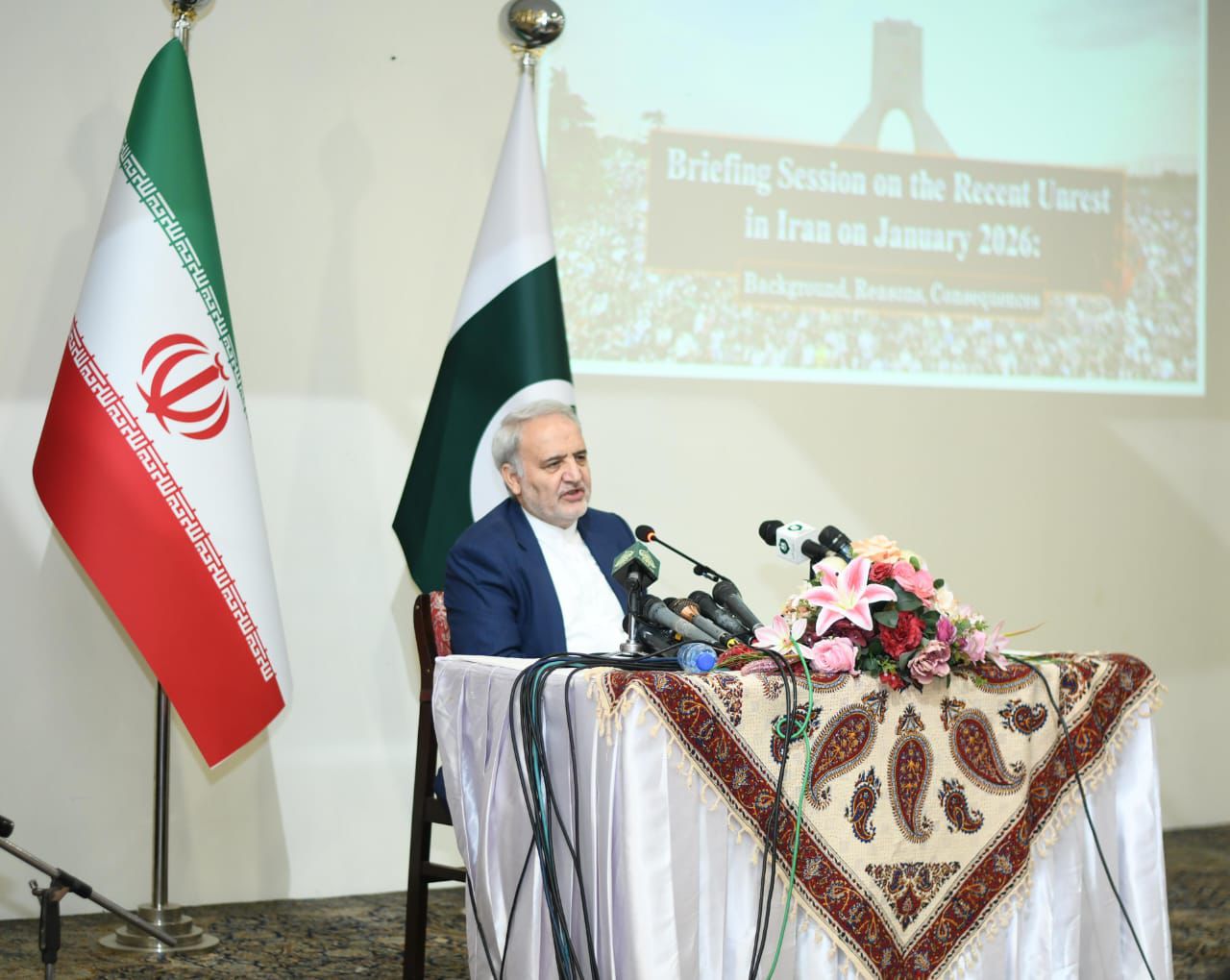
ISLAMABAD, Jan 30 (Diplomatic Star): Ambassador of the Islamic Republic of Iran to Pakistan, Reza Amiri Moghadam, on Thursday underscored that Iran does not seek war but will firmly exercise its right to self-defence in the face of any external aggression, stressing that Tehran continues to prioritise diplomacy and regional stability despite mounting challenges.
Addressing a detailed media briefing at the Iranian Embassy in Islamabad, Ambassador Moghadam said Iran’s policy was rooted in peace, dialogue and respect for international norms, but made it clear that safeguarding national sovereignty and security remained a red line.
He said Iran had repeatedly conveyed its position to the international community that it neither desires conflict nor intends to escalate tensions, yet it would not hesitate to respond if attacked.
“Iran does not want war. We want peace and stability in the region,” the ambassador said. “However, every country has the legitimate right to defend itself against any form of aggression, and Iran will exercise this right if necessary.”
The ambassador highlighted Pakistan’s constructive and supportive role in promoting de-escalation, expressing gratitude to Islamabad for its efforts to help avert conflict and encourage dialogue.
He said Pakistan’s stance reflected the deep-rooted brotherly relations between the two neighbouring countries and their shared interest in regional peace.
Touching upon Iran’s internal situation, Ambassador Moghadam said the Iranian government had taken concrete measures to manage economic challenges, particularly inflation, while ensuring market stability.
He acknowledged that economic pressures had affected segments of society but said the government was actively working to mitigate these issues through policy reforms and social support mechanisms.
He emphasised that the Iranian leadership recognised the constitutional right of citizens to protest and express their concerns.
According to him, initial demonstrations were peaceful and patriotic in nature, with protesters carrying images of the Supreme Leader and Iranian flags, reflecting their desire for reform rather than confrontation.
“The Supreme Leader clearly instructed the government to address the problems of the protesting individuals,” Moghadam said.
He added that, in an unprecedented step, representatives of the protesters were invited to attend a cabinet meeting to directly convey their grievances and suggestions to senior government officials.
However, the ambassador drew a clear distinction between peaceful protesters and violent elements who later infiltrated demonstrations.
He said that as protests escalated, certain groups resorted to violence, targeting public property, government buildings and security personnel. Such actions, he stressed, did not represent the genuine demands of ordinary citizens.
“These violent acts were carried out by organised groups using modern weapons,” he said, adding that attacks on security forces and critical infrastructure could not be justified under the guise of protest.
He reiterated that while Iran remained committed to addressing legitimate public concerns, the state also had a responsibility to maintain law and order.
Ambassador Moghadam shared what he described as alarming figures related to the unrest, stating that more than 3,000 people had lost their lives during the violent phase of the protests, including a significant number of security personnel.
He said the country had also suffered extensive damage to both government and civilian infrastructure, further straining national resources.
Despite these challenges, he said the Iranian government continued to focus on dialogue, reconciliation and reforms aimed at addressing the root causes of public dissatisfaction.
He stressed that maintaining national security and territorial integrity was essential for any meaningful progress on economic and social fronts.
On regional and international issues, the ambassador reiterated that Iran had no intention of targeting any head of state or pursuing aggressive policies against other nations.
He said Tehran’s approach remained centred on diplomacy, engagement and peaceful coexistence, particularly with neighbouring countries and regional partners.
“Iran believes that problems should be resolved through dialogue and political means, not through war,” he said. He added that accusations portraying Iran as a destabilising force were often politically motivated and ignored the country’s repeated calls for negotiations and mutual respect.
Ambassador Moghadam also warned that continued external pressure, sanctions and threats could undermine diplomatic efforts and push the region towards greater instability.
He said sustainable peace required acknowledging the legitimate security concerns of all states and refraining from actions that could escalate tensions.
In his concluding remarks, the ambassador reiterated Iran’s commitment to peace while cautioning that preparedness for defence was a necessity in an uncertain global environment.
He expressed hope that diplomatic initiatives would succeed in preventing conflict, noting that the responsibility lay with all parties involved.
“There is still hope that there will be no war,” he said. “But the success of these efforts is in our hands, and in the hands of the opposing party. If diplomacy prevails, peace will prevail.”
The briefing reflected Iran’s attempt to project a balanced message of restraint and resolve, as regional dynamics continue to evolve amid heightened geopolitical tensions.
Observers say Iran’s emphasis on diplomacy, coupled with assertions of self-defence, signals its intent to deter aggression while keeping channels of engagement open with the international community.