 https://twitter.com/home https://www.facebook.com/Shabbir.Hussain191
By Shabbir Hussain
ISLAMABAD, May 21 (Diplomatic Star): Policymakers, diplomats, industry experts and development partners on Thursday called for urgent policy reforms, green financing mechanisms and stronger public-private coordination to help Pakistan’s textile sector comply with emerging international climate regulations and maintain its competitiveness in global markets.
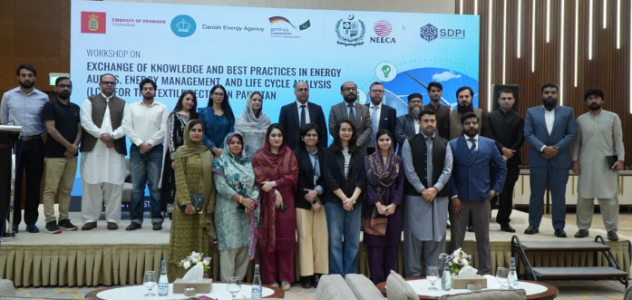
The recommendations were made during a workshop on “Exchange of Knowledge and Best Practices in Energy Audits, Energy Management, and Life Cycle Analysis (LCA) for the Textile Sector in Pakistan,” jointly organized by the Danish Energy Agency, the Sustainable Development Policy Institute (SDPI), the National Energy Efficiency and Conservation Authority (NEECA) and the Embassy of Denmark.
Participants warned that rapidly evolving environmental regulations in key export markets, particularly the European Union, are reshaping global trade requirements and creating new compliance obligations for exporters.
They stressed that without immediate action, Pakistan’s textile industry—the backbone of the country’s export economy—could face increasing challenges in retaining access to international markets.
Opening the workshop, Danish Ambassador to Pakistan, Maja Mortensen, said the challenge was no longer developing energy transition policies but ensuring their effective implementation.
She emphasized that energy efficiency was closely linked with economic resilience, energy security and national stability, particularly at a time when countries are facing global energy supply disruptions and rising energy costs.
Drawing on Denmark’s experience following the oil crisis of the 1970s, she noted that long-term planning, institutional reforms and strong collaboration between the public and private sectors enabled Denmark to emerge as a global leader in renewable energy and industrial energy efficiency.
The ambassador announced that Pakistan and Denmark had entered into a three-year Strategic Sector Cooperation programme in the energy sector that will continue until 2029. The initiative aims to provide a structured framework for technical cooperation, policy dialogue and implementation support.
“Green transition and economic growth can go hand in hand,” she said, adding that industries adopting energy-efficient practices are more competitive and better prepared to meet future market requirements.
German Ambassador to Pakistan, Ina Lepel, highlighted the growing significance of new European Union regulations, including the Carbon Border Adjustment Mechanism (CBAM), sustainability reporting requirements and life-cycle-based environmental standards.
She warned that these measures are increasingly becoming mandatory conditions for market access and could significantly affect Pakistan’s textile exports if companies fail to provide verified environmental performance data.
Pakistan’s textile sector contributes nearly 60 percent of the country’s export earnings and remains one of the most important pillars of the national economy. However, Lepel cautioned that exporters unable to demonstrate compliance with environmental standards risk losing business to competitors with stronger sustainability credentials.
“Pakistani textile exporters who cannot demonstrate their environmental performance risk losing contracts to competitors who can,” she said.
She expressed particular concern about the vulnerability of small and medium enterprises (SMEs), which often lack the financial resources and technical capacity required to meet new sustainability requirements.
She called for stronger incentives, targeted support programmes and wider adoption of sustainable technologies to facilitate compliance and support the sector’s transition toward greener production.
Executive Director of SDPI, Abid Qaiyum Suleri, stressed the need for evidence-based policies that reduce dependence on imported fuels through greater energy efficiency and renewable energy adoption.
He noted that energy audits, energy management systems and life-cycle analysis can help industries optimize energy consumption, improve productivity and reduce operating costs while contributing to broader national economic objectives.
Dr. Suleri also linked Pakistan’s energy challenges to wider geopolitical uncertainties and fiscal pressures, arguing that governments across the world are increasingly rethinking industrial and energy planning strategies amid shifting global supply chains and regional instability.
Country Manager of the Danish Energy Agency, Nadeem Niwaz, described the Pakistan-Denmark Green Strategic Partnership as evidence of Denmark’s recognition of Pakistan’s strategic importance in global energy transition efforts.
He explained that Denmark’s international energy partnerships are tailored to the unique needs of each partner country and focus on long-term government-to-government cooperation aimed at promoting clean energy and industrial efficiency.
Senior Technical Expert at Viegand Maagøe, Fridolin Holm, highlighted the energy-intensive nature of Pakistan’s textile industry, which continues to rely heavily on fossil fuels despite increasing international pressure to reduce carbon emissions.
According to Holm, the textile sector accounts for approximately 28 percent of industrial electricity consumption and 40 percent of industrial gas usage in Pakistan. He warned that exporters lacking certified carbon emissions data could face severe financial consequences under the EU’s CBAM framework.
Without verified CO₂ reporting, exporters may be subjected to default emissions values that effectively function as permanent penalties on exports, potentially undermining Pakistan’s trade competitiveness and threatening the continuation of its GSP+ benefits in European markets.
Holm recommended that industries adopt internationally recognized standards such as ISO 50001 to establish effective energy management systems and improve monitoring of energy consumption and emissions.
Technical Life Cycle Analysis expert Lasse Vinblad Thaisen said evolving EU textile regulations are transforming global supply chains and creating growing demand for verified environmental data from suppliers.
He explained that tools such as Life Cycle Analysis (LCA) and Product Environmental Footprint (PEF) assessments are becoming increasingly important for measuring environmental impacts throughout a product’s lifecycle, including water consumption, chemical usage and ecosystem effects.
Associate Research Fellow and Head of Ecological Sustainability and Circular Economy at SDPI, Zainab Naeem, highlighted Pakistan’s progress in textile recycling and circular economy initiatives.
She noted that the country currently recycles nearly 89 percent of textile waste, with major recycling hubs operating in Karachi, Faisalabad and Chiniot.
However, she identified untreated wastewater, chemical discharge management, shortages of skilled labour and regulatory ambiguities as major challenges requiring immediate policy attention.
During a panel discussion, Head of Compliance at the National Compliance Centre of the Ministry of Commerce, Nabeel Amin, argued that Pakistan should develop its own compliance framework tailored to local conditions rather than simply replicating foreign models.
He also called for integrated green financing mechanisms to support SMEs and informal businesses in adopting cleaner technologies and strengthening compliance capabilities.
Representing the National Productivity Organization (NPO), Aftab Khan emphasized that many SMEs continue to face significant gaps in technical expertise, management systems and financial resources required for sustainability compliance.
He stressed the importance of government subsidies, targeted financing programmes, stronger industry-government coordination and expanded technical training initiatives to help Pakistan’s textile sector adapt to changing global environmental standards while preserving export growth and international competitiveness.
Participants concluded that immediate action on energy efficiency, sustainability reporting, climate compliance and green financing would be critical for ensuring the long-term resilience and global competitiveness of Pakistan’s textile industry in an increasingly carbon-conscious world.