 https://twitter.com/home https://www.facebook.com/Shabbir.Hussain191
By Shabbir Hussain
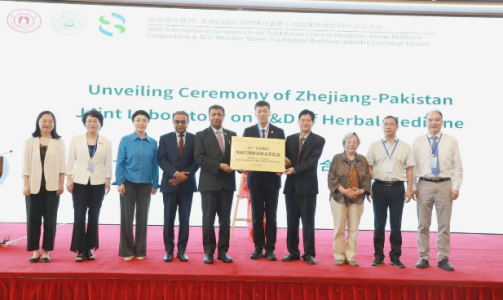
ISLAMABAD, June 6 (Diplomatic Star): In a major step toward strengthening scientific cooperation in traditional medicine, China, Pakistan and the Ministerial Standing Committee on Scientific and Technological Cooperation of the Organization of Islamic Cooperation (OIC-COMSTECH) on Saturday launched a Joint Laboratory on Research and Development of Herbal Medicine.
It was announced during the 2026 International Symposium on Traditional Chinese Medicine (TCM)-Unani Medicine Cooperation and SCO Member States Traditional Medicine Industry Exchange Forum at Ningbo University in Zhejiang Province, China.
The state-of-the-art laboratory, established through collaboration between Ningbo University and COMSTECH, aims to promote research, innovation and international cooperation in Traditional Chinese Medicine and Unani Medicine.
The initiative will focus on herbal medicine development, clinical and pre-clinical research, international registration of traditional medicine products, academic exchanges, capacity building and the training of young scientists.
It is expected to become a leading platform for advancing evidence-based traditional medicine and fostering healthcare innovation across Asia and the Muslim world.
Addressing the inaugural ceremony, Muhammad Iqbal Choudhary, Coordinator General of COMSTECH, described the launch as a landmark achievement in China-Pakistan scientific cooperation.
He said the two countries have built a strong partnership in traditional medicine over the past two decades through joint research projects, scientist exchanges, clinical studies and institutional collaborations.
Prof. Choudhary noted that cooperation between Pakistani and Chinese institutions has contributed significantly to advances in herbal medicine research, medicinal plant studies, pharmacology and healthcare innovation.
He expressed confidence that the newly established laboratory would further strengthen collaborative research, product development, academic networking and capacity-building efforts.
He emphasized that the successful China-Pakistan model of cooperation should be expanded to benefit other developing countries and member states of the Organization of Islamic Cooperation (OIC).
He also announced plans to organize a Traditional Medicine Summit in Islamabad, bringing together scientists, policymakers, regulators and industry leaders from across the Muslim world to enhance collaboration in traditional medicine research and innovation.
The joint laboratory will bring together a multidisciplinary team of 50 researchers, including 30 Chinese and 20 international experts.
The research team will cover a broad range of disciplines, including medicine, pharmacy, biology, chemistry, artificial intelligence, policy studies and regulatory sciences.
Speaking at the event, Zhao Yufen, a member of the Chinese Academy of Sciences and Dean of the Institute of Drug Discovery Technology at Ningbo University, highlighted the importance of international collaboration in advancing traditional medicine.
She said the laboratory would provide an effective platform for integrating scientific expertise from different countries, encouraging joint research initiatives and accelerating the evidence-based development of traditional medicine products for global healthcare markets.
Under the laboratory’s governance structure, Prof. Zhao Yufen will chair the Academic Committee, while Liu Xinmin will serve as the Chinese Director. Prof. Muhammad Iqbal Choudhary, who is also Chief Scientist at the University of Karachi and University of Lahore, will serve as the Pakistani Director.
The inaugural session was attended by senior diplomats, scientists and policymakers, including Shehzad Ahmad Khan, Khan Muhammad Wazir, Qingqing Wang, Yaowu Zhang, Zeng Fan, Jing Liao and Dongping Meng.
Participants from China, Pakistan, SCO member states and other countries discussed opportunities for research collaboration, product development, regulatory harmonization, commercialization and future partnerships in traditional medicine.
According to COMSTECH, the newly established laboratory is expected to play a pivotal role in advancing scientific research, innovation, talent development and healthcare applications in traditional medicine across China, Pakistan, OIC member states and SCO countries.
The initiative is also expected to strengthen South-South cooperation and contribute to the global recognition and modernization of traditional medicine systems.