 https://twitter.com/home https://www.facebook.com/Shabbir.Hussain191
By Shabbir Hussain
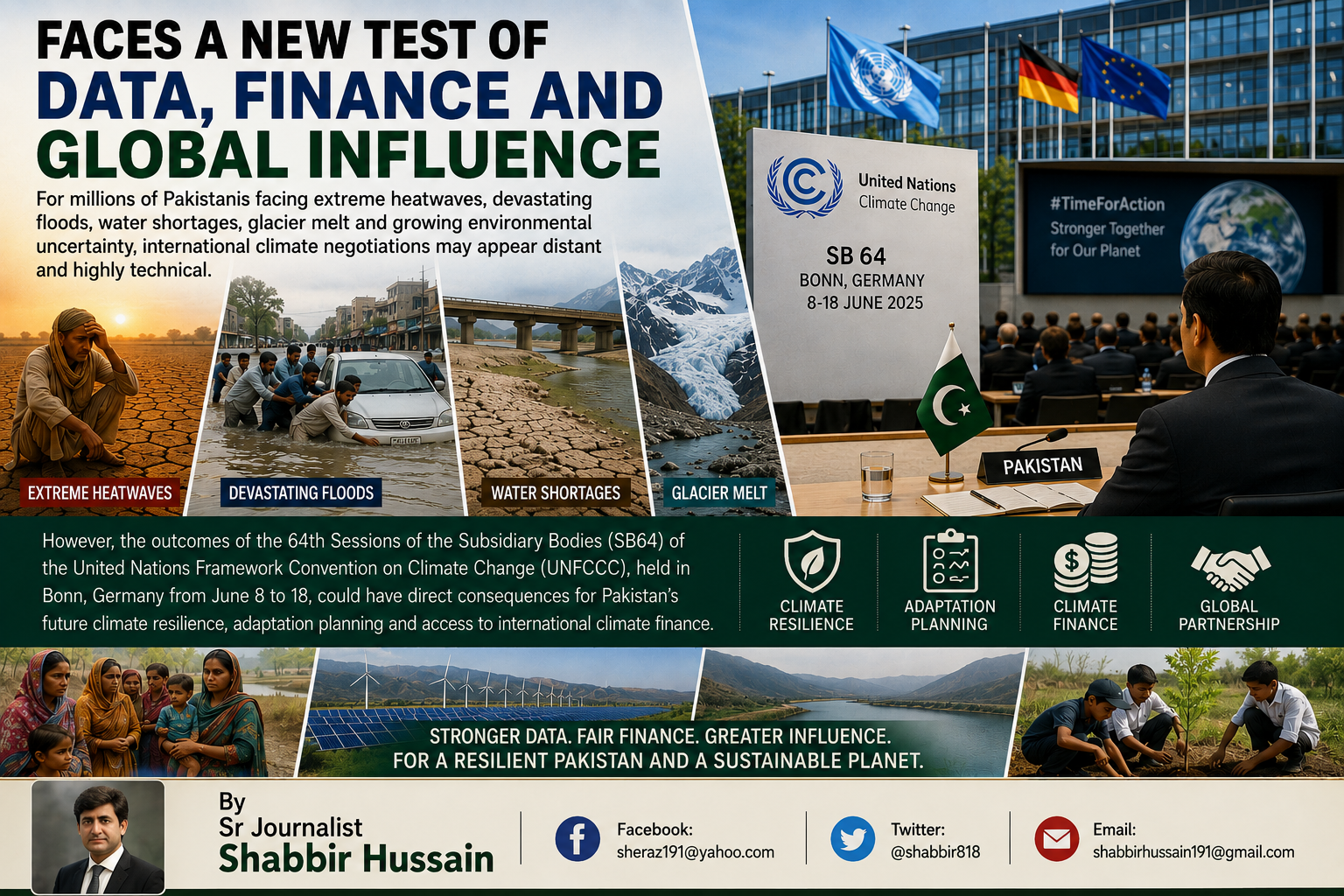
ISLAMABAD, Jun 29 (Diplomatic Star): For millions of Pakistanis facing extreme heatwaves, devastating floods, water shortages, glacier melt and growing environmental uncertainty, international climate negotiations may appear distant and highly technical.
However, the outcomes of the 64th Sessions of the Subsidiary Bodies (SB64) of the United Nations Framework Convention on Climate Change (UNFCCC), held in Bonn, Germany from June 8 to 18, could have direct consequences for Pakistan’s future climate resilience, adaptation planning and access to international climate finance.
Unlike major climate summits such as the Conference of the Parties (COP), where political announcements and global commitments often dominate headlines, the Bonn negotiations focus on developing the technical foundations of climate action.
Experts believe that SB64 has marked a significant shift in global climate diplomacy, moving from setting ambitious targets towards measuring implementation, accountability and results.
The discussions in Bonn showed that the future of climate negotiations will increasingly depend on evidence, scientific data, transparency mechanisms and the ability of countries to demonstrate measurable progress.
Pakistan, one of the world’s most climate-vulnerable countries, is closely watching these developments as climate impacts continue to affect communities across Punjab, Sindh, Balochistan, Khyber Pakhtunkhwa and Gilgit-Baltistan.
Climate experts say Pakistan can no longer rely only on highlighting its vulnerability; instead, it must strengthen its scientific capacity, climate data systems and negotiation strategies to secure a stronger position in future global discussions.
Climate expert and environmental analyst Dr. Shahid Hamid said Pakistan’s climate diplomacy must now move beyond describing disasters and focus on presenting measurable evidence of climate impacts.
“Pakistan has repeatedly demonstrated that it is highly vulnerable to climate change, but the international climate system is becoming more focused on data, indicators and measurable outcomes. We need stronger research, better climate monitoring systems and scientific documentation to convert our challenges into effective negotiation arguments,” he said.
He added that Pakistan’s future climate strategy should integrate water security, food systems, urban planning, health and disaster preparedness because climate change is no longer only an environmental issue but a development and economic challenge.
The Bonn sessions placed significant attention on the Global Goal on Adaptation (GGA), with negotiators working on methodologies and technical systems to assess adaptation progress. The development of adaptation indicators is expected to influence how countries measure resilience and how future climate finance priorities are determined.
For Pakistan, this development carries major importance because adaptation has historically remained difficult to quantify. Unlike reducing greenhouse gas emissions, where progress can be measured through emission data, adaptation involves complex issues such as community resilience, infrastructure protection, agricultural sustainability and disaster preparedness.
Officials from Pakistan’s Ministry of Climate Change and Environmental Coordination said the country was closely engaged in international climate discussions and was advocating for stronger support for vulnerable developing countries.
A senior official of the ministry said Pakistan’s position remained focused on climate justice, adaptation financing, technology transfer and capacity building.
“Pakistan has contributed very little to global emissions but remains among the countries most affected by climate change. Our priority is to ensure that global climate mechanisms recognize the needs of vulnerable countries and provide resources for adaptation and resilience,” the official said.
The official added that Pakistan was working to improve climate governance, strengthen early warning systems and enhance coordination between federal and provincial institutions to address climate challenges.
The SB64 discussions also highlighted the increasing importance of oceans, food systems, climate science and nature-based solutions. Countries discussed the role of marine ecosystems, coastal resilience and sustainable development approaches in responding to climate change.
For Pakistan, experts say these areas are increasingly relevant due to challenges such as coastal vulnerability in Sindh, changing rainfall patterns, declining water availability and threats to agricultural productivity.
Climate researcher Dr. Aisha Khan said Pakistan needed to broaden its climate diplomacy approach by connecting climate issues with economic development, regional cooperation and national security.
“Climate change is directly linked with water, agriculture, migration, health and economic stability. Pakistan needs a comprehensive strategy where climate diplomacy is treated as a central part of foreign policy and economic planning,” she said.
One of the major challenges highlighted during the Bonn negotiations was the continuing gap between developed and developing countries over climate finance.
Developing nations argued that existing financial commitments remain insufficient compared to the scale of climate impacts they face. They called for increased public financing, technology transfer and support for vulnerable communities.
For Pakistan, this debate is especially significant as the country faces enormous climate financing requirements while managing economic pressures. The government estimates that Pakistan requires hundreds of billions of dollars by 2030 to meet climate adaptation and mitigation needs.
Experts argue that climate finance should not be viewed only as environmental assistance but as an investment in economic stability, disaster prevention and sustainable development.
The road towards COP31 is expected to focus heavily on adaptation finance, implementation of the Global Goal on Adaptation, just transition mechanisms and the role of developing countries in shaping climate policies.
Analysts believe Pakistan must strengthen its climate diplomacy by creating a permanent network of scientists, negotiators, researchers and policy experts who can engage throughout the year rather than only during major climate conferences.
Dr. Hamid said effective climate diplomacy requires preparation beyond international events.
“Climate negotiations are not won only during COP meetings. The real work happens throughout the year through research, alliances and technical engagement. Pakistan needs to be part of the process where decisions are shaped,” he said.
Pakistan also has opportunities to build stronger alliances with climate-vulnerable countries, including members of the G77 and China, Least Developed Countries and Small Island Developing States. Cooperation on water security, food systems, mountain ecosystems and climate resilience could help Pakistan play a larger role in global climate discussions.
Experts believe the country should shift from being seen only as a victim of climate change towards becoming an active contributor to global solutions.
The devastating floods of 2022, recurring heatwaves and growing climate risks have already placed Pakistan among the countries most affected by global warming. However, analysts say future influence will depend on how effectively Pakistan transforms these experiences into scientific evidence, diplomatic proposals and international partnerships.
The Bonn negotiations sent a clear message that the global climate system is entering a new phase. The era of negotiating frameworks is gradually moving towards implementation, monitoring and accountability.
For Pakistan, the challenge is clear: climate vulnerability alone will not guarantee influence. The countries that shape the future climate agenda will be those that combine scientific knowledge, strong diplomacy, effective partnerships and practical solutions.
As the world moves from Bonn towards COP31, the key question for Pakistan remains whether it will only participate in climate negotiations or actively help shape the decisions that determine the future of vulnerable nations.